
Everyone is on high alert, constantly watching the sky with fright and exhaustion […] We also keep our eyes on our mobile phone connections — the moment the signal drops, we immediately take cover in underground shelters. We’ve come to understand that a loss of communication signals an impending airstrike.
— Humanitarian aid worker on the internet shutdown that took place in Myanmar during air strikes near Tamu township in the Sagaing region.
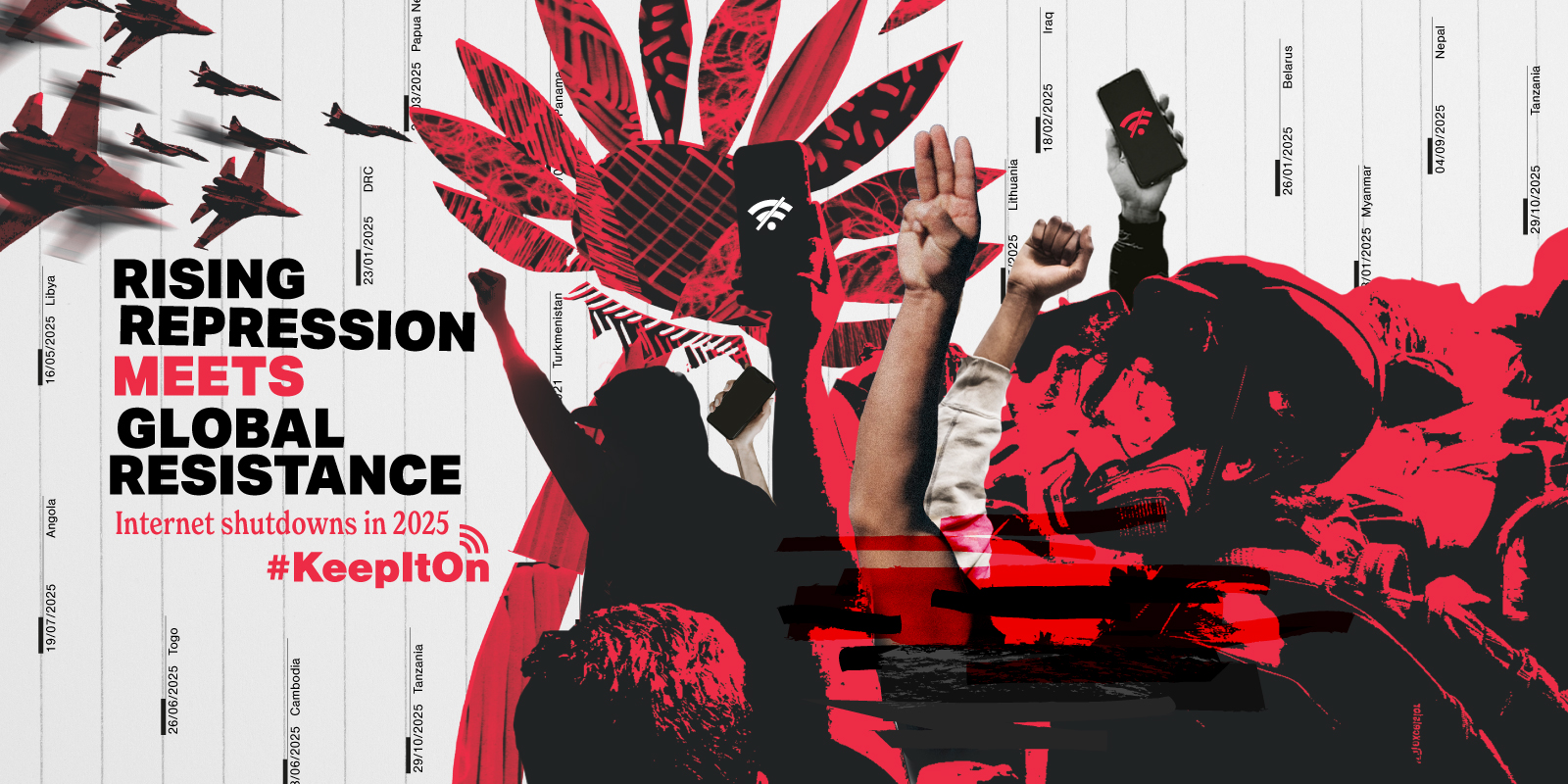
The 2025 data and analysis confirm a horrific reality: internet shutdowns are increasing, not decreasing — and their impact on people’s lives is devastating. Shutdowns reached a new record high in the past year, continuing the steady increase since 2020. Our new report, Rising repression meets global resistance: Internet shutdowns in 2025, documents how democratic and autocratic governments alike deploy them to silence, collectively punish, and terrorize populations, as well as to hide human rights violations and killings. At the same time, we highlight how resistance is growing and people’s power is rising, and offer recommendations for stakeholders to push back. From Myanmar to Iran, Tanzania to Nepal, communities are challenging repression, demanding accountability, and devising new ways to reconnect during blackouts.
In 2025, Access Now and the #KeepItOn coalition documented 313 shutdowns in 52 countries, surpassing the appalling records from 2024 (304) and 2023 (289). Seven new countries joined the offender list in 2025, meaning that people in 100 countries have now experienced a shutdown since we started tracking in 2016. As 2026 began, there were 75 shutdowns in 33 countries that persisted from 2025, a significant increase from the 54 shutdowns in 26 countries that were ongoing from 2024 into 2025. This shows that perpetrators are increasingly attempting to permanently block communications platforms or even keep entire populations cut off from the internet indefinitely.
If you can’t see the highlights below, please check your privacy-enhancing browser extensions. Open in desktop view for the best experience.
Conflict was the leading trigger for internet shutdowns for a third year running, with 125 conflict-related shutdowns documented across 14 countries as perpetrators regularly cut off internet access to conceal war crimes and atrocities and terrorize populations.
We also saw a continued persistence in cross-border shutdowns: there were 18 such shutdowns implemented by seven perpetrators, impacting people in seven countries and colonized or occupied territories, compounding suffering and harm primarily in areas of protracted conflict. As populations fought to stay connected, we saw a sharp increase in perpetrators targeting Low Earth Orbit (LEO) satellite internet systems, which have become a lifeline during digital blackouts and brutal violence. There were 14 such shutdowns across seven countries in 2025, compared to four shutdowns of this type in 2024.

For several years now, due to lawfare and state-sponsored violence like abductions, citizen journalism has been the most reliable form of reporting in Tanzania. On October 29, 2025, authorities turned their weapons on citizens on the streets, in shops, in bars, and at home. Thousands were shot and killed under the cover of a complete internet blackout. Brave citizens recorded these atrocities. Despite the shutdown preventing immediate wide sharing, we were able to disseminate the information online in small batches for the rest of the world to see. When the blackout ended, this evidence became integral for documenting the crackdown
— Tanzanian activist Maria Sarungi
Grave human rights abuses continue under the cover of shutdowns
In 2025, we documented 70 shutdowns coinciding with grave human rights abuses, such as murder, torture, rape, or apparent war crimes and atrocities, in 21 countries. People were cut off during the world’s worst active humanitarian crisis in Sudan; during Israel’s unfolding genocide in Gaza; and during protests amid violent police crackdowns in countries like Kenya, Libya, Myanmar, Pakistan, and Tanzania. Shutdowns during conflict and other crises result in a wide spectrum of human harms, and it often isn’t until later that we learn the full truth of what happened on the ground.
We do know that shutdowns are growing increasingly dangerous, inflicting profound and immeasurable harm on people and communities. When perpetrators impose shutdowns in blatant violation of international human rights standards, it erodes public trust in democratic systems and enables states to commit heinous crimes against populations with impunity (content note: video link for heinous crimes contains graphic content).
Given that there have been at least 241 shutdowns coinciding with grave human rights abuses since 2022 alone, the #KeepItOn coalition continues to call for investigations into international crimes to consider how internet shutdowns can conceal evidence, can show the intent of an existing policy to harm people, and may directly facilitate or contribute to international crimes.
The worst entrenched offenders systematically impose shutdowns
Any actor imposing even a single internet shutdown is doing so in defiance of human rights. However, some perpetrators impose shutdowns lasting for months or years, with others institutionalizing the tactic with shocking regularity. The past year was no exception. People in Myanmar experienced a record 95 shutdowns imposed by nine perpetrators in 2025, with the majority (76) carried out by the military regime. Authorities in India (65), Pakistan (20), and Iran (11) continued to disrupt the internet or block platforms in a wide range of contexts, while authorities in Tanzania imposed a punishing set of shutdowns (8) to crack down on dissent — a notably sharp increase from 2024 (3).
Meanwhile, in Russia, people experienced an unprecedented increase in the number of shutdowns in 2025. Emerging information indicates the government imposed hundreds to thousands of disruptions across virtually every region, broadly justified as countermeasures against drone attacks despite evidence that mobile internet is not strictly needed to operate drones and the fact that many disruptions were implemented in areas without drone attacks. As we work to verify and document these events with our partners, the current data in our Shutdown Tracker Optimization Project (STOP) catalogs 20 shutdowns imposed by Russian authorities, with 17 imposed domestically and three in Ukraine.
Fighting back in 2025: resistance, solidarity, and impact
Thanks to sustained advocacy by civil society and allied actors, it is now widely recognized that internet shutdowns violate fundamental rights and cannot be normalized. The fight against internet shutdowns has moved firmly onto the global agenda, with a number of key stakeholders taking action in 2025.
For example, after years of campaigning by the #KeepItOn coalition to expose how election shutdowns undermine democratic processes — particularly elections — election observers have for the first time acknowledged the threat and publicly condemned the practice, following Tanzania’s five-day internet blackout during the October 2025 elections. Similarly, the African Commission on Human and Peoples’ Rights (ACHPR) spoke out against the violent crackdown and nationwide internet blackout in Tanzania in 2025, and later condemned the January 2026 disruptions in Uganda. The Freedom Online Coalition (FOC), a partnership of 41 countries working to advance internet freedom, published a statement opposing the growing normalization of internet shutdowns in times of armed conflict. And Bangladesh took steps toward outlawing shutdowns.
We are also encouraged to see the International Criminal Court (ICC) recognize the link between internet shutdowns and crimes against humanity.
As we mark the 10th anniversary of the #KeepItOn coalition in 2026, we pay tribute to the growing resistance, deeper solidarity, and renewed resilience among those committed to defending fundamental freedoms in the digital era.
The advocacy of our coalition and partners has compelled governments to reverse, end, or provide explanations for shutdown orders in 2025, in addition to helping people and communities learn tactics and tools to stay connected. We continue to mobilize efforts against shutdowns, including through supporting strategic litigation, with several cases still pending.
Shutdowns strip citizens of their fundamental right to access information that may be vital to their safety and survival. It is this reality that led the Bloggers Association of Kenya (BAKE), ICJ Kenya, Paradigm Initiative, ARTICLE 19, CIPESA, and other partners to take a stand. Together, we have challenged four internet shutdowns before the Kenya High Court. It’s our hope that this case will not only reclaim the right of Kenyans to remain connected but also send a clear message: such overreach cannot happen again. Ultimately, we want this case to serve as a landmark precedent for the rest of Africa and the Global Majority, providing a legal roadmap for how to defeat internet shutdowns in the halls of justice
— BAKE
We need all hands on deck
Not a single day of 2025 passed without at least one internet shutdown. As perpetrators continue to use internet shutdowns to terrorize and collectively punish communities, this fight can no longer rest with civil society alone. It demands collective action, continuous funding and investment, and sustained accountability from all who have the power to act.
Our 2025 report offers concrete recommendations for states, regional and international bodies, private companies, and funders, each of whom have a critical role to play in advancing an open, secure, and inclusive internet for all. This includes an urgent call for governments, regulators, satellite providers, and international institutions to confront the growing threat to LEO satellite access by accelerating and supporting alternative connectivity solutions such as direct-to-cell satellite connectivity. People suffering through conflict, war, and humanitarian crises need this vital lifeline — now.
Our message, going forward: we won’t rest until all actors cease deliberate network disruptions. Please join us as we work toward a future where connectivity is no longer a weapon, but instead protected as an essential lifeline and an enabler of fundamental rights.